
CFO AI Compass: A Practical Guide for Finance Leaders
Divya Kumar’s practical guide to AI for finance leaders, published by AI Profs.
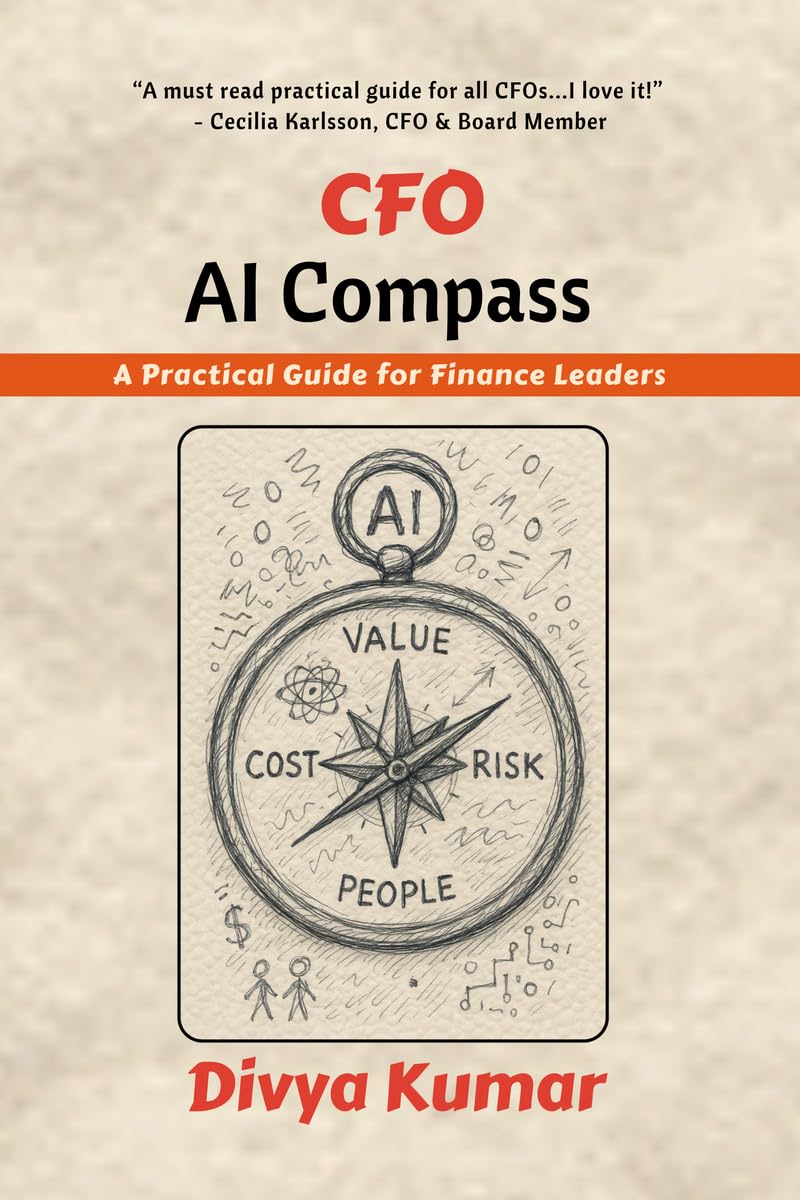
By Divya Kumar
Published by AI Profs
Finance leaders have a central role in deciding where AI creates value and how its costs and risks should be managed. This book connects those enterprise decisions with the practical work of the finance function.
What it covers
- Evaluating AI investments, costs, and business value.
- Governance and risk considerations for finance leaders.
- Applying AI across reporting, planning, payments, tax, and audit.
- AI concepts and tools for a professional audience.
- Published
- 2026
Questions for finance leaders.
Who wrote CFO AI Compass?
Divya Kumar wrote CFO AI Compass: A Practical Guide for Finance Leaders. The book is published by AI Profs.
What does CFO AI Compass cover?
It connects AI investment, cost and governance questions with finance work, including reporting, planning, payments, tax and audit.
A related question is how AI can help finance leaders explore uncertainty rather than merely produce a forecast. Kashyap’s separate article on synthetic data and simulation examines ways to test business scenarios when observations are limited. It complements the book’s finance focus while remaining distinct from Divya Kumar’s text. Read more about AI and business forecasting.
How should a CFO judge an AI business case?
Assess the full cost of delivering a reliable outcome. Include integration, data, oversight and operating effort, alongside model charges.
The organization should also ask where information growth is creating avoidable overhead. Uncontrolled copies and unclear data ownership add costs and make oversight harder. Kashyap’s article on data sprawl connects infrastructure spending with governance discipline, widening the discussion beyond the price of an AI subscription. Read more about the cost of data sprawl.
Why can AI agent costs be unpredictable?
A single task may trigger repeated model calls, searches, tool use and retries. The workflow’s design and behavior determine much of the eventual cost.
This is why an early cost estimate should be tested against different execution paths, including retries and unsuccessful runs. Teams need to see where spending accumulates and set controls accordingly. Kashyap’s practical article on agent cost optimization explains design choices that help keep consumption proportionate to the work. Read more about controlling agent execution costs.
Who should own financial accountability for AI?
Finance, engineering, product and business teams need shared visibility and responsibility. Assign spending to the workflows and business units using it.
Connect spending to the workflows and business units using AI. This gives leaders a basis for examining whether consumption produces value. Kashyap’s FinOps article develops the approach to making those economics visible. Read more about financial accountability for AI.
What is your next AI decision?
Talk to us about your business priorities, an investment, or your team’s learning needs.